
 Call buy:

 Vietnamese
 English
Market News
Vietnam’s coffee export prices hit a record high of over USD 5,800 per ton.
Vietnam’s average coffee export price during the first 2.5 months of 2025 reached USD 5,614 per ton, surging by as much as 73% compared with the average price of USD 3,228 per ton recorded in the same period of 2024. As a result, Vietnam’s coffee export turnover amounted to USD 2.28 billion in just the first 74 days of 2025.
According to the latest data from Vietnam Customs, from January 1 to March 15, 2025, Vietnam exported 406,637 tons of coffee, down 18% year-on-year. However, the export value reached USD 2.28 billion, marking a sharp increase of 41% compared with USD 1.6 billion in the same period of 2024. This growth was mainly driven by the 73% rise in Vietnam’s average coffee export price, from USD 3,228 per ton a year earlier to USD 5,614 per ton during the current period.
Coffee export value surges across multiple markets
Vietnam currently exports coffee to 36 major markets, with all key destinations recording strong growth compared with the same period last year. Germany remained Vietnam’s largest coffee export market in the first two months of 2025, with export value reaching USD 278 million, up 79% from USD 155 million a year earlier.
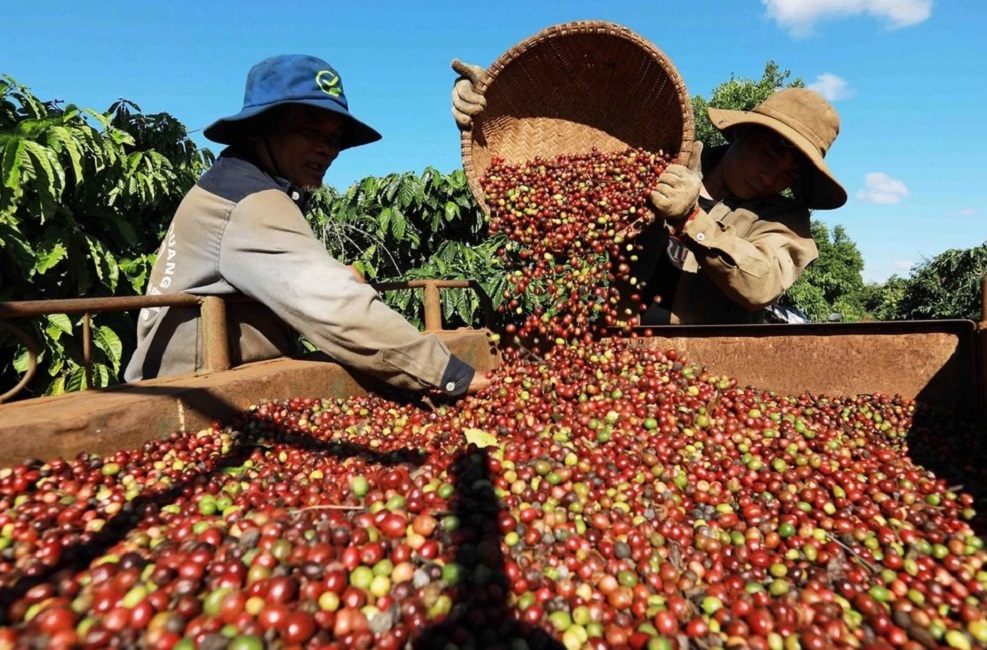
Italy ranked second with coffee export turnover of USD 171 million, up 31% year-on-year. Other markets with export values exceeding USD 100 million included Japan with USD 127 million (up 56%), the United States with USD 120 million (up 53%), and Spain with USD 117 million (up 29%).
Total coffee export turnover to these five markets during the first two months of 2025 reached USD 815 million, up 52% year-on-year, accounting for 37% of Vietnam’s total coffee exports.
Several markets posted exceptionally strong growth during this period. Coffee export value to South Africa surged by 5,166%, rising from USD 0.15 million to USD 7.9 million, while export volume jumped from 41 tons to 1,479 tons. Coffee exports to Mexico also soared by 2,147%, from USD 1.17 million to USD 26.2 million, with volume increasing from 427 tons to 5,235 tons.
In the first two months of 2025, Vietnam’s coffee exports to France rose 174% in value to USD 29.4 million; exports to Poland increased 213% to USD 33.7 million; Malaysia recorded an 82% increase to USD 32 million; Thailand rose 94% to USD 34.8 million; the UK grew 60% to USD 40.4 million; and Algeria rose 63% to USD 76 million.
Within ASEAN, Vietnam exported USD 0.2 million worth of coffee to Laos (up 100%); USD 1.1 million to Myanmar (down 69%); USD 1.24 million to Singapore (down 22%); USD 2.6 million to Cambodia (up 168%); USD 43 million to the Philippines (up 21%); and USD 44 million to Indonesia (down 37%) compared with the same period last year.
Coffee prices set new records in March
In 2024, Vietnam exported 1.34 million tons of coffee, achieving a record export value of USD 5.62 billion. Although export volume fell by 17.1% compared with 2023, export value rose by 32.5%. The average coffee export price in 2024 also hit a record high of USD 4,177 per ton, up 59% from USD 2,613 per ton in 2023.
Since the beginning of 2025, global coffee prices have continued to set new records. At the close of last weekend’s trading session (March 22, 2025), arabica coffee futures for May delivery on the New York exchange stood at 391.40 cents per pound (1 pound equals 0.4535 kg), up 14.20 cents from the previous week’s level of 377.20 cents per pound.
At this level, arabica coffee prices are equivalent to approximately USD 8,630 per ton—the highest on record. Meanwhile, robusta coffee prices on the New York exchange closed at USD 5,515 per ton, up sharply by USD 118 per ton from the previous week’s closing price of USD 5,397 per ton (March 15). On the London exchange, robusta coffee futures for May 2025 delivery stood at USD 5,515 per ton on March 22, up USD 18 per ton from March 21.
Domestically, on March 24, 2024, Vietnam’s average domestic coffee price reached VND 133,900 per kilogram, up VND 400 per kilogram from the previous day. The highest purchase prices in key Central Highlands provinces—Đắk Lắk, Lâm Đồng, Gia Lai, Đắk Nông, and Kon Tum—were recorded at VND 134,000 per kilogram.
Regarding export prices, the Vietnam Coffee and Cocoa Association reported that by mid-March 2025, Vietnam’s coffee export price had reached a new record of USD 5,803 per ton, up 74.5% compared with mid-March 2024.
Analysts attribute the rapid rise in coffee prices primarily to declining export volumes from the world’s two largest coffee exporters, Brazil and Vietnam. According to a report released by the Brazilian Coffee Exporters Council (Cecafe) last Thursday, Brazil’s green coffee exports in February 2025 fell by 12% year-on-year to 3 million bags.
Earlier, on January 28, 2025, Brazil’s government crop forecasting agency Conab projected that the country’s 2025/26 coffee harvest would decline by 4.4% from the previous year to a three-year low of 51.81 million bags. Reports indicate that last year’s El Niño-induced drought may cause long-term damage to coffee crops in South and Central America. Rainfall in Brazil has remained below average since April last year, placing stress on coffee trees during the critical flowering stage and reducing prospects for the 2025/26 arabica crop.
Meanwhile, concerns are also growing over Vietnam’s coffee crop after weather forecasters in Đắk Lắk warned that the Central Highlands—the country’s main coffee-growing region—are expected to experience hotter weather and lower rainfall between March 21 and March 31, 2025. In the first two months of 2025, Vietnam’s coffee export volume declined by 14.8% year-on-year.
According to a report released in mid-March 2025 by the Food and Agriculture Organization of the United Nations (FAO), if supply shortages persist in major coffee-growing regions, global coffee export prices could rise further in 2025.
FAO made this assessment amid a 38.8% increase in global coffee prices in 2024 compared with the 2023 average. The organization noted that the record-high prices of both arabica and robusta coffee are not driven by inflation adjustments, but primarily by climate-related disruptions to production.
Meanwhile, although the United States has not yet raised tariffs on coffee imports from the Americas, concerns over potential tariff increases are prompting coffee businesses in North America and Brazil to prepare contingency plans. Several Mexican coffee companies have relocated roasting and packaging facilities to both the United States and Canada to mitigate the risk of higher U.S. tariffs on Mexican goods.
“Currently, the United States is still postponing the 25% tariff on goods from Mexico, but if the tariff policy changes, we will have to adapt accordingly,” Starbucks CEO Brian Niccol said at a recent shareholder meeting.
Bill Murray, President of the National Coffee Association of the United States, warned that if the U.S. imposes high tariffs on coffee from Brazil and other North American suppliers, coffee prices in the U.S. market could surge further, with consumers bearing the cost—given that three-quarters of the U.S. population consumes coffee.
RELATED
Banana prices hit a record high.
15/01/2026
Vietnam’s Export Banana Varieties
15/01/2026